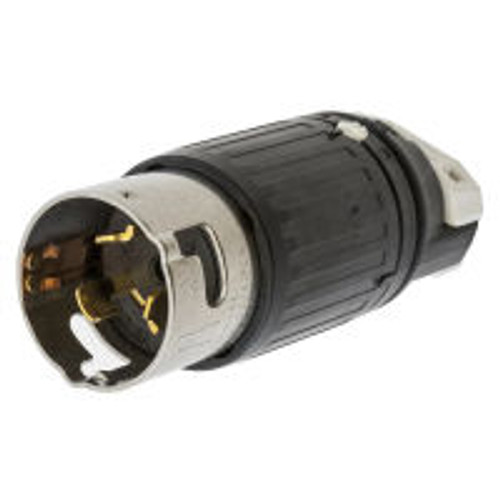

Key Features
- CS8165C
- 480 Volts / 50 Amp
- UL, CSA
Documentation
- Technical Drawing
- Certificate of Compliance
- Certificate of Origin
- REACH Compliance
- RoHS Compliance
- Prop 65 Declaration
- WEEE Compliance
- Product Lifecycle Statement
- ISO 9001:2015 QMS Certificate
Specifications
| Amperage | 50 Amp |
| Certifications | UL, CSA |
| Cord Grip Range | .830" - 1.25" (21.1 - 31.75mm) |
| Plug | CS8165C |
| Poles / Wires | 3p / 4w |
| Terminal Accommodation | 8 - 4 AWG |
| Voltage | 480 Volts |
Application Notes
- Port & Shipyard Power Distribution: Commonly used to connect heavy-duty power cords for container cranes, reefer units, and shipboard systems. Their keyed configurations prevent misconnection between U.S. shore power and foreign vessel systems.
- Entertainment & Events: Widely used in outdoor film sets, concert venues, and festivals to distribute high-amperage power to lighting rigs, trailers, and stage gear, especially where rugged, weather-resistant connections are needed.
- Construction & Industrial Sites: Suited for temporary power distribution in job sites, powering welding equipment, portable panels, compressors, and other 240V or 480V three-phase machinery.
- Emergency & Utility Services: Used in mobile power units, disaster recovery, and utility trucks for quick connection to temporary power grids or portable generators.
- Marinas & Shipboard Systems: Ideal for connecting shore power to boats and ships, especially those with foreign voltage systems. The center pin configuration ensures equipment cannot be energized incorrectly.
- Mobile & Temporary Structures: Frequently used in mobile command centers, trailers, and pop-up medical facilities that require high-capacity power with safe, secure connections.
Product FAQs
What is a California Standard (CS) plug?
California Standard plugs are heavy-duty, keyed electrical connectors designed for 50A service at 125V, 250V, or 480V. They’re commonly used in industrial, entertainment, marine, and construction applications.
Why were California Standard plugs developed?
They were developed to prevent voltage mismatches at shipping ports. Each plug has a unique blade pattern and a center rejection pin to block improper connections between different voltage systems.
Where are CS plugs commonly used?
They’re found in ports, shipyards, film and event power distribution, industrial sites, construction zones, and temporary power setups like mobile trailers and command centers.
Can I use a CS plug with a standard NEMA connector?
No. CS plugs are intentionally incompatible with NEMA or other plug types to enforce voltage separation and ensure safety during connection.