
What InfoComm 2026 revealed about the next IT sourcing challenge
Jun 30th 2026
InfoComm 2026 closed last week in Las Vegas with a headline that wasn't about any single product. It was about a shift in how enterprise technology gets built: AV and IT are no longer separate stacks.
For years, audiovisual systems and IT infrastructure lived in different organizational silos; different budgets, different vendors, different teams. AVIXA's own framing for this year's show made that explicit: convergence is now structural, not incidental. Meeting rooms, broadcast studios, analytics, signage, and AI tools are increasingly running on the same underlying infrastructure.
That shift matters far beyond the show floor. It changes what "IT sourcing" actually means for the teams responsible for deploying it.
The convergence problem, in practice
The clearest example came from the AI conversation, which spanned 46 sessions at InfoComm 2026. The question running through nearly all of them wasn't whether to deploy AI in collaboration tools and AV systems, that decision is already made in most enterprises. The real question was how to do it reliably across thousands of rooms, endpoints, and distributed locations without creating new layers of management complexity.
The answer, as Microsoft and Cisco both framed it in their keynotes, comes down to a few architectural requirements. Room systems need enterprise-grade hardware at the foundation; capable cameras, proper audio processing, reliable network infrastructure; because AI features built on top of weak hardware simply don't perform. Cisco's "Connected Intelligence" framing made a similar point: AI-enabled infrastructure only works when collaboration platforms, devices, and networks are integrated under one coherent system, not assembled from whatever happened to be available when each component was purchased.
That's a sourcing problem before it's a technology problem.
What changes for procurement and IT teams
When AV and IT converge, the procurement conversation changes shape. A meeting room upgrade is no longer just a camera and a display, it's compute, networking equipment, power infrastructure, and software working as one system. A multi-location AI rollout is no longer "buy 50 cameras", it's a coordinated deployment where hardware quality, delivery timing, and consistency across sites all affect whether the system performs the way it was designed to.
This creates two challenges that show up consistently in organizations trying to scale these deployments:
Consistency across locations. When the same AI-enabled room system needs to roll out across multiple offices; potentially across multiple countries; sourcing the same hardware specification reliably becomes the hard part. A camera or compute unit that performs well in one location but ships with a different firmware version or arrives weeks late in another location undermines the entire deployment's consistency.
Timing tied to a broader rollout. AI-enabled infrastructure deployments are rarely standalone projects. They're tied to a broader workplace strategy, a hybrid work initiative, or an enterprise communications upgrade with its own timeline. When the hardware sourcing component slips, it doesn't just delay a shipment, it delays the rollout schedule that other teams are already planning around.
Neither challenge is new to enterprise IT. What's new is the scale at which they're showing up, as more organizations move from piloting AI-enabled collaboration tools to deploying them across their full real estate footprint.
Where this intersects with cross-border operations
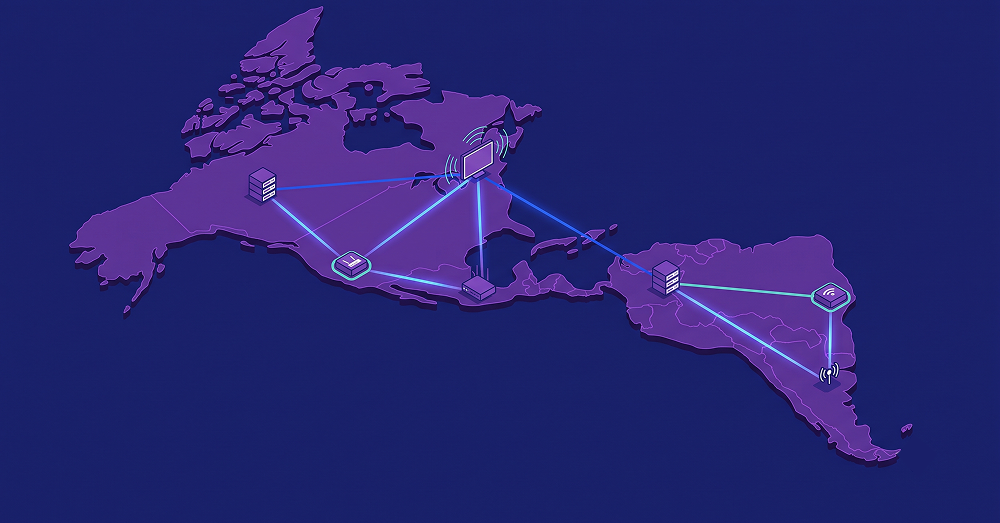
For organizations operating across the Americas, this convergence adds a layer of complexity that wasn't part of the conversation in Las Vegas: getting consistent, reliable hardware to multiple countries on a timeline that supports a unified rollout.
A company standardizing on a connected room system across offices in the US, Mexico, and Brazil isn't just buying hardware three times. It's managing import requirements, customs timelines, and last-mile delivery that vary by country, while trying to keep the deployment timeline consistent enough that the rollout actually feels unified to the people using it.
This is the exact problem that shows up when AV and IT infrastructure decisions are made without factoring in how the equipment will actually move from a manufacturer to dozens of physical sites across different regulatory environments.
The sourcing question worth asking now
InfoComm 2026 made the technology case for convergence clearly. What it didn't address, because it's not really an AV industry question, is how organizations actually get that infrastructure deployed consistently across every location that needs it.
That's increasingly the gap between a successful AI-enabled workplace rollout and one that stalls halfway through. The technology decision happens in a conference room. The execution happens across however many sites, countries, and customs processes stand between the purchase order and the installation.
Organizations planning AV-IT convergence projects across the Americas are better served treating sourcing and logistics as part of the technology decision, not as a separate problem to solve after the spec sheet is finalized.
Tropical IT sources IT infrastructure across the Americas through a single-partner model. If your organization is planning a multi-country technology rollout, let's talk.