
Key Features
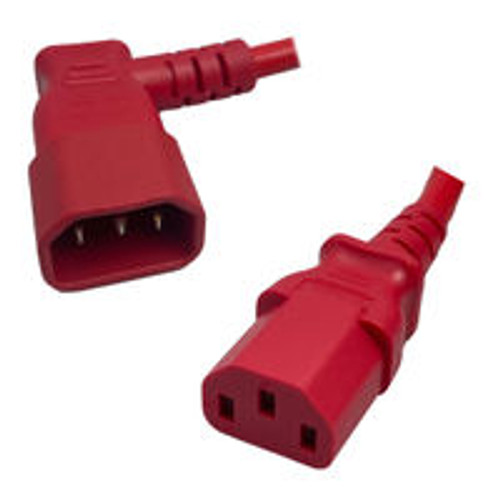
- IEC 60320 C14 plug to Left C15 connector
- Angled connectors reduce cable strain
- C15 connector is backwards compatible — mates with both C14 and C16 inlets
- C15 rated for higher-temperature applications (up to 120°C) compared to standard C13
- Rated for 10 Amps, 250 Volts AC
- 18 AWG conductors
- North America SJT cable jacket
- 0.9 Meter / 3 Feet cord length
Documentation
- Technical Drawing
- Certificate of Compliance
- Certificate of Origin
- REACH Compliance
- RoHS Compliance
- Prop 65 Declaration
- WEEE Compliance
- Product Lifecycle Statement
- ISO 9001:2015 QMS Certificate
Specifications
| Voltage | 250 Volts |
| Amperage | 10 Amps |
| Male Plug | IEC320 C14 |
| Female Connector | IEC320 C15 |
| Female Angle | Left |
| Length | 0.9 Meter / 3 Feet |
| Conductor Gauge | 18 AWG |
| Conductors | 3 Wire |
| Conductor Color Code | Black, White, Green | North American Color Code (NACC) |
| Outside Diameter | 7.6-8.0mm |
| Packaging | Loose & Bundled |
| Cable Jacket | North America SJT |
| Jacket Material | PVC |
| Jacket Temp. Rating | 105° C |
| Color | Black |
| Testing | Each cord is tested for dielectric voltage-withstand (Hi-Pot), polarization and continuity. |
| Certifications | UL/cUL, Sony Green Partner |
Application Notes
IEC 60320 Angled power cords are designed for high-density rack deployments where cable management at one or both ends is a priority. Angled connectors redirect the cord parallel to the PDU face or equipment chassis rather than projecting straight outward, reducing the clearance required and minimizing mechanical stress on the connectors over time.
The angle orientation at each end can be selected independently to suit the specific rack layout and cable routing requirements of the installation. This flexibility makes angled C14-to-C15 cords especially useful in tight spaces where straight cords would create excessive cable bulk or limit airflow behind the rack.
The C15 connector's 120°C temperature rating makes it the preferred choice for high-temperature server and networking equipment. It is backwards compatible with both C14 and C16 inlets, allowing a single cord to serve equipment with either inlet type without requiring separate SKUs.
Product FAQs
What is the advantage of angled connectors?
Angled connectors route the cord parallel to the PDU face or equipment chassis rather than projecting straight outward. This reduces the depth required at the connection point, improves cable routing in tight spaces, and reduces mechanical stress on the connectors — extending service life in high-density rack environments.
What is the difference between a C13 and a C15 connector?
Both C13 and C15 are IEC 60320 connectors, but the C15 is rated for higher-temperature applications — up to 120°C compared to 70°C for the C13. The C15 is also backwards compatible, meaning it mates with both C14 and C16 inlets. It is the preferred connector for equipment that runs hot or is specifically designed for high-temperature operation.
How do I choose the right conductor gauge?
Conductor gauge determines the current-carrying capacity of the cord. A heavier gauge (lower AWG number) supports higher amperage loads, while a lighter gauge (higher AWG number) is more flexible and suited for lower-load devices. Always select a gauge that meets or exceeds the amperage requirements of your circuit and connected equipment.
What does the cable jacket affect?
The cable jacket affects flexibility, durability, and suitability for specific environments. SJT is more durable and rigid than SVT cordage.