
Key Features
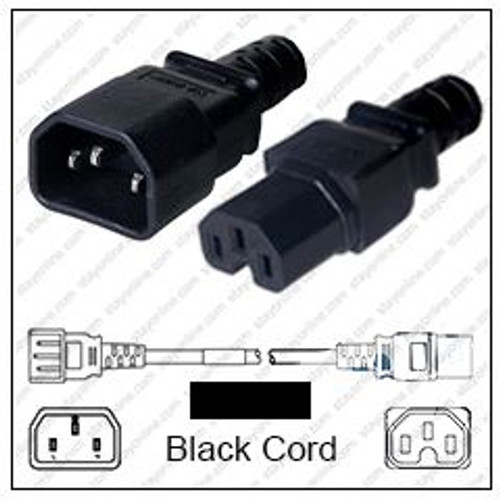
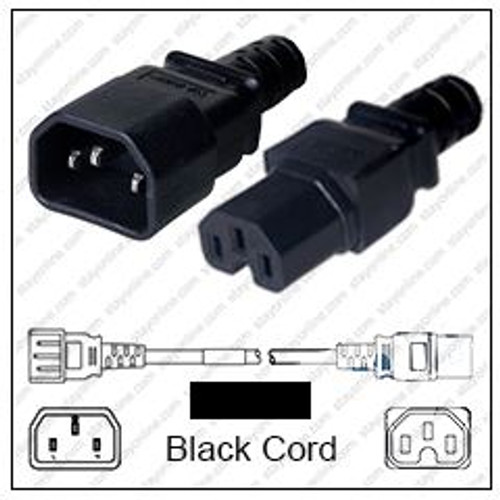
- Standard IEC 60320 C14 plug to C15 connector
- C15 connector is backwards compatible — mates with both C14 and C16 inlets
- C15 rated for higher-temperature applications (up to 120°C) compared to standard C13
- Rated for 13 Amps, 250 Volts AC
- 16 AWG conductors
- North America SJT cable jacket
- 1.2 Meter / 4 Feet cord length
Documentation
- Technical Drawing
- Certificate of Compliance
- Certificate of Origin
- REACH Compliance
- RoHS Compliance
- Prop 65 Declaration
- WEEE Compliance
- Product Lifecycle Statement
- ISO 9001:2015 QMS Certificate
Specifications
| Male Plug | IEC320 C14 |
| Female Connector | IEC320 C15 |
| Voltage | 250 Volts |
| Amperage | 13 Amps |
| Length | 1.2 Meter / 4 Feet |
| Tolerance | ± 35 mm / ± 1.4 inches for molded cords± 50 mm / ± 2 inches for mechanical cords |
| Conductor Gauge | 16 AWG |
| Conductor Count | 3 wires |
| Conductor Color Code | Black, White, Green | North American Color Code (NACC) |
| Outside Diameter | 8.2-8.6mm |
| Cable Jacket | North America SJT |
| Jacket Material | PVC |
| Jacket Temperature Rating | 105° C |
| Color | Black |
| Testing | Each cord is tested for dielectric voltage-withstand (Hi-Pot), polarization and continuity. |
| Certification(s) | US & Canada - cULus |
| Packaging | Loose & Bundled |
Application Notes
IEC 60320 C14 to C15 power cords connect standard C14-outlet PDUs to equipment with a C14 or C16 inlet, with the C15 connector's 120°C temperature rating making it the preferred choice for high-temperature server and networking equipment. The C15 is backwards compatible with both C14 and C16 inlets, providing flexibility across a wide range of devices without requiring separate cord SKUs for each inlet type.
Compared to a standard C13 connector, the C15's higher temperature rating makes it well-suited for equipment that runs hot or operates in environments where ambient temperatures are elevated. This makes C14-to-C15 cords a reliable upgrade over C14-to-C13 cords in applications where thermal performance is a consideration.
C14 to C15 cords are commonly used in data centers, colocation facilities, and enterprise server rooms where high-temperature-rated connectivity is required between standard PDU outlets and rack-mounted servers, storage, or networking equipment.
Product FAQs
What is the difference between a C13 and a C15 connector?
Both C13 and C15 are IEC 60320 connectors, but the C15 is rated for higher-temperature applications — up to 120°C compared to 70°C for the C13. The C15 is also backwards compatible, meaning it mates with both C14 and C16 inlets. It is the preferred connector for equipment that runs hot or is specifically designed for high-temperature operation.
Is the C15 connector backwards compatible with C14 inlets?
Yes. The C15 connector is designed to mate with both C14 and C16 inlets. This makes C14-to-C15 cords suitable for a wide range of equipment, including devices with either inlet type, without requiring separate cord SKUs for each.
How do I choose the right conductor gauge?
Conductor gauge determines the current-carrying capacity of the cord. A heavier gauge (lower AWG number) supports higher amperage loads, while a lighter gauge (higher AWG number) is more flexible and suited for lower-load devices. Always select a gauge that meets or exceeds the amperage requirements of your circuit and connected equipment.
What does the cable jacket affect?
The cable jacket affects flexibility, durability, and suitability for specific environments. SJT is more durable and rigid than SVT cordage.